
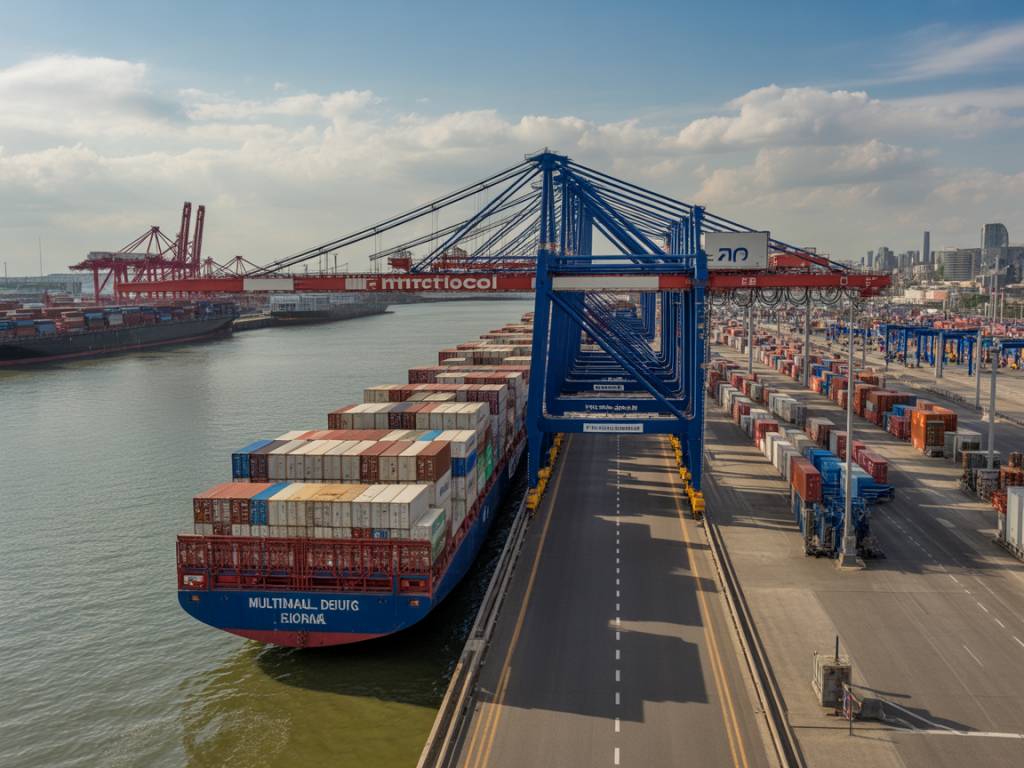
Why End-to-End Visibility Has Become the Backbone of Multimodal Logistics
Global supply chains are under pressure from every angle: volatile demand, port congestion, capacity constraints, rising costs, and increasingly strict customer expectations. In this environment, end-to-end visibility across multimodal logistics networks is no longer a “nice to have” feature. It is a strategic capability.
From the moment a container is unloaded at the port to the instant a parcel reaches the customer’s curb, shippers and logistics service providers need real-time, actionable information. This is what transforms a complex multimodal flow—combining ocean freight, rail, road, air, and last-mile delivery—into a truly orchestrated logistics network.
End-to-end visibility does more than show where a shipment is located. It contextualizes events (customs delays, missed transshipments, traffic congestion, weather disruptions), predicts their impact on estimated time of arrival (ETA), and proposes alternatives. For businesses trying to protect service levels and optimize transport spend, this level of insight is essential.
Defining End-to-End Visibility in Multimodal Logistics Networks
End-to-end visibility in multimodal logistics refers to the ability to track and manage shipments across every leg of their journey, regardless of carrier, mode, or region. It connects siloed transport operations into a unified, data-driven network.
In practice, this means having a consistent, live view of:
- Container status from port of loading to port of discharge and inland terminal
- Intermodal transfers between ocean, rail, barge, and truck
- Warehouse and cross-dock operations, including inbound and outbound flows
- Middle-mile movements between distribution centers and hubs
- Last-mile delivery activities up to the curb or doorstep
True multimodal visibility breaks down operational silos by integrating transport management systems (TMS), warehouse management systems (WMS), carriers’ telematics, IoT devices, and external data sources such as port community systems or customs platforms.
From Port to Curb: Mapping the Critical Visibility Milestones
The logistics journey from port to curb can be broken down into key milestones where visibility provides the highest value. Each stage has its own constraints, actors, and data sources.
Visibility at the Port and Terminal Level
Ports are often the starting point for global multimodal flows. However, they are also major bottlenecks. Having granular visibility in and around the port area can significantly improve planning accuracy.
Key visibility requirements include:
- Real-time container status: arrival, unloading, customs clearance, inspection, and gate-out times
- Accurate vessel ETA/ETD and berth planning information
- Terminal congestion indicators and yard dwell times
- Linkage between container IDs, booking numbers, and inland transport orders
Advanced visibility platforms rely on integrations with port community systems, ocean carrier APIs, and sometimes AIS (Automatic Identification System) vessel tracking to provide more reliable ETAs and exception alerts.
Orchestrating Inland Multimodal Transport
Once containers leave the port, they enter a complex inland network that can involve rail, barge, and long-haul trucking. At this stage, the challenge is to maintain a continuous “thread of data” across multiple carriers and modes.
Important elements of inland transport visibility include:
- Real-time GPS positions for trucks, barges, and trains
- Gate-in/gate-out events at rail terminals and inland depots
- Estimated arrival times at cross-docks, regional distribution centers, or customer facilities
- Dynamic routing and re-routing options in case of disruption
In practice, orchestrating this layer requires strong integration between the TMS, telematics providers, and carrier systems. For shippers, having a unified platform that normalizes data across dozens of carriers is one of the most effective ways to achieve network-wide visibility.
Warehouse and Hub Visibility: The Missing Link
Multimodal visibility frequently breaks down when shipments enter warehouses and cross-docks. Inventory sits in a “black box” while transportation teams wait for updates. Yet the alignment between transport and warehousing is critical for on-time delivery.
Key visibility points at this level are:
- Inbound arrival times and unloading status
- Put-away, picking, and packing progress
- Dock scheduling and door assignment for outbound shipments
- Inventory availability synchronized with transport plans
Integrating WMS and TMS data creates a closed-loop view of inventory in motion. This allows planners to adjust outbound routes based on real stock availability and to prioritize shipments at risk of missing their delivery slots.
Last-Mile Delivery and Curbside Transparency
The final leg of the journey is also the most visible to end customers. Last-mile delivery is where service failures become customer complaints, and where transparency can become a key differentiator.
Modern last-mile visibility solutions provide:
- Real-time tracking links for consignees and end customers
- Dynamic ETAs updated based on traffic and route changes
- Proof of delivery (POD) with photos, signatures, or geolocation stamps
- Delivery exceptions, such as failed attempts or access issues, surfaced in real time
For retailers, e-commerce players, and parcel carriers, investing in last-mile visibility tools—such as route optimization software and customer-facing tracking portals—drives both customer satisfaction and operational efficiency.
Key Technologies Powering End-to-End Logistics Visibility
Bringing these pieces together from port to curb requires an ecosystem of complementary technologies. No single system can provide full visibility on its own; instead, logistics organizations must orchestrate a connected stack.
Some of the core technologies include:
- Transport Management Systems (TMS): Backbone platforms for planning, executing, and settling freight movements, now increasingly enhanced with real-time data and predictive analytics.
- Real-Time Visibility Platforms (RTVPs): Tools that aggregate GPS, telematics, ELD, AIS, and carrier data to provide shipment-level tracking and predictive ETAs across carriers and modes.
- Warehouse Management Systems (WMS): Solutions that manage inbound, storage, and outbound logistics, and increasingly expose live data to transport planners.
- IoT Sensors and Asset Tracking Devices: Devices installed on containers, trailers, pallets, or even high-value items to monitor location, temperature, shock, humidity, or door openings.
- APIs and Integration Platforms: Middleware that connects carriers, shippers, forwarders, ports, and customers, enabling near real-time data exchange.
- Advanced Analytics and AI: Algorithms that detect patterns, predict delays, propose alternative routes, or optimize network design based on historical and live data.
Organizations that invest in an integrated, API-first architecture are best positioned to scale visibility across their entire multimodal logistics network.
Overcoming the Main Challenges of Multimodal Visibility
Despite growing maturity in the technology ecosystem, orchestrating end-to-end visibility remains challenging. Several recurring obstacles appear in most projects.
The most common challenges include:
- Data fragmentation: Different carriers and partners use heterogeneous systems, formats, and standards, making aggregation complex.
- Resistance to sharing information: Some actors fear losing competitive advantage or exposing performance issues when they share detailed operational data.
- Incomplete device coverage: Not every truck, wagon, or container is equipped with a tracking device, especially in fragmented markets with many small carriers.
- Inconsistent data quality: Manual scans, delayed status updates, or incorrect events can degrade trust in the visibility solution.
- Change management: Planners and operators must adapt to new tools, dashboards, and data-driven decision processes.
Successful visibility programs therefore combine technology investment with a structured approach to governance, partner agreements, and user adoption.
Business Benefits: From Reactive Tracking to Proactive Orchestration
The primary value of end-to-end visibility lies in shifting from reactive shipment tracking to proactive logistics orchestration. When data flows in real time, organizations can anticipate problems and simulate alternatives.
Common business benefits include:
- Improved on-time performance: Early detection of delays enables rebooking, expediting, or proactive communication with customers.
- Lower logistics costs: Better capacity utilization, fewer detention and demurrage charges, and optimized routing reduce total transport spend.
- Reduced safety stock: Reliable lead times and fewer surprises allow businesses to lower inventory buffers without increasing risk.
- Higher customer satisfaction: Transparent, accurate ETAs and proactive alerts improve the delivery experience, especially in B2C and retail.
- Stronger resilience: During disruptions such as strikes, port closures, or extreme weather events, visibility supports faster scenario planning and reconfiguration.
In short, visibility turns the logistics network from a static chain into a dynamic, responsive system.
Practical Steps to Build End-to-End Visibility
For companies looking to enhance multimodal visibility, the journey typically progresses in stages. It is often more realistic to prioritize lanes, regions, or key customers before expanding network-wide.
Some practical steps include:
- Mapping current data sources, systems, and gaps across all modes and partners
- Defining a clear visibility strategy aligned with service and cost objectives
- Selecting a TMS and/or real-time visibility platform capable of multi-carrier, multimodal tracking
- Onboarding priority carriers and logistics service providers via APIs or EDI integrations
- Equipping high-value assets with IoT sensors where traditional tracking is insufficient
- Designing dashboards and alerts tailored to planners, customer service, and management
- Measuring performance with KPIs such as on-time delivery, dwell times, and forecast accuracy
Many companies also work with specialized technology vendors and consulting firms to accelerate integration and shorten time-to-value.
How Technology Buyers Can Evaluate Visibility Solutions
For logistics managers and supply chain leaders considering investments in visibility solutions or related hardware, a structured evaluation approach is essential. Beyond the feature checklist, decision-makers should consider:
- Coverage: Number of integrated carriers, modes, and regions; depth of port and terminal data.
- Data latency and accuracy: Frequency of updates, predictive ETA performance, and incident detection capabilities.
- Integration flexibility: Availability of APIs, connectors to major TMS/WMS/ERP systems, and support for EDI standards.
- User experience: Quality of dashboards, mobile interfaces, configurable alerts, and reporting tools.
- Scalability and security: Ability to handle large shipment volumes with robust data protection.
- Total cost of ownership: Licensing, onboarding, hardware costs (for IoT devices), and internal resource requirements.
This evaluation framework can be applied both to software platforms and to hardware such as GPS trackers, container sensors, or telematics equipment for fleets.
The Future of Port-to-Curb Visibility
As global trade flows evolve and logistics networks become more interconnected, port-to-curb visibility will continue to mature. Several trends are already reshaping the landscape:
- Growing adoption of standardized data models in ocean and air freight
- Integration of sustainability metrics, such as CO2 emissions, into visibility dashboards
- More affordable and energy-efficient IoT devices for containers, pallets, and cargo
- Use of machine learning to predict disruptions and automate decisions at scale
- Expansion of collaborative platforms that allow shippers, carriers, and logistics providers to share data securely
In this environment, companies that succeed in orchestrating end-to-end visibility across their multimodal logistics networks will be better positioned to control costs, protect service levels, and adapt to continuous change—from the port all the way to the curb.